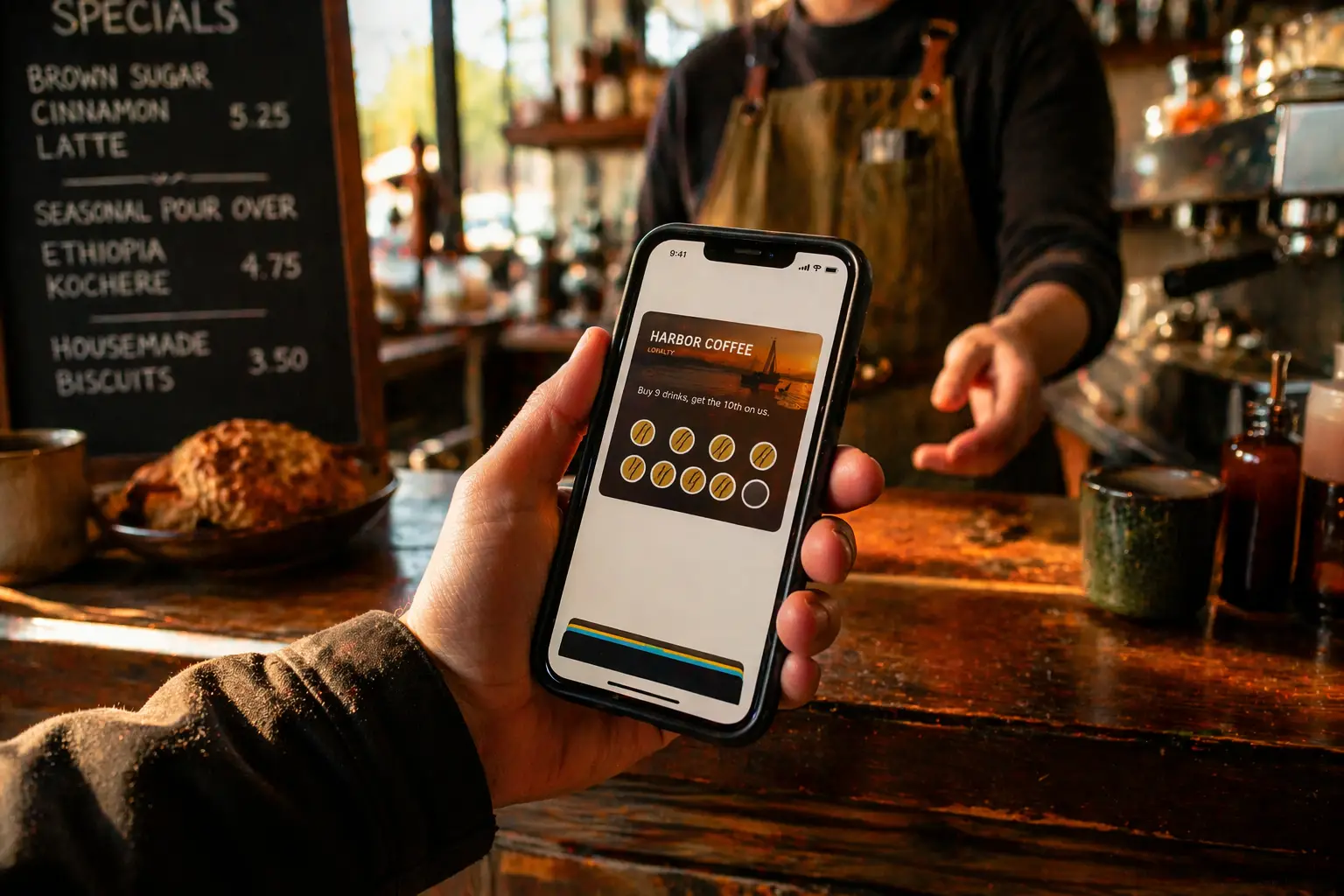
In brief: Most SMBs never launch a loyalty program because setup is too complex and expensive. AI changes that: a real loyalty program can now go live in under a week, with no technical hire, and pays for itself in the first two to three weeks of incremental revenue.
Every restaurant owner, retail manager, and venue operator knows they should have a loyalty program. The data is clear: repeat customers are more profitable, loyalty programs increase repeat visits, and systematic retention beats constant acquisition.
Most SMBs don't have one. Or they have one that's inactive, enrollment is terrible, and the program doesn't move the needle.
The barrier isn't ignorance. It's complexity. Building a real loyalty program has traditionally required months of planning, significant capital investment, ongoing platform management, and integration with your POS system. For a restaurant with 80 employees and thin margins, that's a legitimate blocker.
What changed: AI can now abstract away most of that complexity. A real loyalty program can be operational in under a week. The setup is simple. The return starts immediately.
A loyalty program is a structured system that rewards repeat customers with points, discounts, or perks, increasing visit frequency and average spend while reducing a business's dependence on constant new customer acquisition. For SMBs, the math is simple: repeat customers are 5–7x cheaper to retain than new ones are to acquire.
Why Most Small Businesses Don't Have Loyalty Programs
Start with the assumption that a typical SMB owner wants to run a loyalty program. What stops them?
First, complexity. A proper program requires a database to store customer data, a way to track purchases, a method to reward customers, and integration with your existing systems. Each component is a separate problem. You need a consultant or technical hire to architect it. That's expensive and slow.
Second, capital. Setting up infrastructure, integrating with your POS, running a pilot. The all-in cost used to be $20K–$50K before you had a single customer in the program.
Third, operational overhead. Once live, someone has to manage it. Monitor enrollment, troubleshoot customer issues, analyze which rewards drive behavior, iterate. For a restaurant with a manager already working 55 hours a week, that's a non-starter.
Fourth, the paradox of proof. You can't know if a loyalty program will work for your specific business without running one. But you're not going to invest $40K and four months to find out. So you don't start.
Most SMBs solve this problem by doing nothing. They stay on the acquisition treadmill. New customer, average spend, never seen again. Repeat 500 times per year. It's expensive, but it's a known cost. Loyalty programs remain theoretical.
What Loyalty Programs Actually Do
Before solving the implementation problem, let's be clear on the business math.
A restaurant with 150 weekly covers, $35 average check, and 85% of customers not returning operates on the acquisition model. That's 130 unique customers per week. You're starting from zero repeat business every Monday.
A restaurant with the same covers and check where 40% of customers are repeat customers has a fundamentally different business. That 40% represents people who know you, like you, and come back. They're the margin that turns a restaurant from precarious to stable. They're more price-forgiving, more likely to spend on premium items, more likely to recommend you.
Loyalty programs systematize repeat business. They give customers a reason to come back, a way to track their loyalty, and a reward that incentivizes the next visit.
The mechanics are simple: customers enroll with low friction, they get rewarded for spending, the reward accumulates toward something valuable, they return to redeem it. The repeat visit happens because friction is reduced and incentive is clear.
For SMBs, the numbers matter. If a loyalty program increases repeat customer percentage from 25% to 40%, that's meaningful. If the repeat customers spend 15% more per visit, that compounds. If they bring one additional customer per visit because they're happier, that's multiplicative.
The total impact: a well-executed loyalty program can generate 20–35% incremental revenue, the range industry studies consistently report.
Why It Matters Now
Two shifts made AI-powered loyalty programs possible.
First, large language models can understand and process business context in natural language. You don't need to build schema, define fields, or set up database structure. You describe your business and your goals in plain language. The system understands it.
Second, modern AI can automate the operational layer. Enrollment is fast. Rewards track automatically. Customer communication is generated intelligently. The system suggests improvements and adapts. You don't manage it. It manages itself.
The result: what used to require a technical hire, a $35K investment, and three months of setup can now be live in days with minimal ongoing effort.
What a Modern Loyalty Launch Looks Like
You describe your business. What you're selling. Who your customer is. How often they come back. What would make them come back more. The AI asks a few clarifying questions and builds a model of your context.
The system designs a loyalty program calibrated to your economics. Not a template. The reward structure reflects your costs and your customer behavior. The enrollment experience fits your customer base.
You connect it to your POS. The system maps your transaction data and sets up the connection. From describe-the-business to live-program: minutes, not months.
Soft launch. Employees know how to enroll customers. Enrollment takes 30 seconds. The system begins collecting data. By end of week, you have early participants.
Month one: the system is learning. It tracks participation, watches which rewards drive behavior, identifies which customer segments are responding. It sends you weekly insights. You see which customers are being retained that wouldn't have been otherwise.
Month two onward: the system optimizes. It flags an underperforming reward and suggests alternatives. It spots that Tuesday afternoon is slow and recommends a time-based incentive. It notices that one menu item is driving loyalty disproportionately and suggests bundling it with another. Each adjustment is tested and measured.
Loyalty Program ROI: The Numbers for a 150-Cover Restaurant
Let's ground this in realistic numbers for a 150-cover restaurant.
Current state: 150 covers per week, $35 average check, 25% repeat customer rate, $5,250 weekly revenue from repeat customers.
After loyalty program, realistic outcomes: repeat customer rate increases to 38%, repeat customers spend 12% more on average, first-time customers convert to repeat at 2x the previous rate. The incremental lift in weekly revenue lands around $3,000–$5,000 depending on your starting baseline.
The investment: a few thousand in setup, a few hundred per month in platform cost, plus roughly four hours per month of your time reviewing insights.
ROI: the program pays for itself in the first two to three weeks of incremental revenue. After that, it's margin.
Scale that across five locations, and you're generating over a million dollars in incremental annual revenue for a fraction of that in annual platform cost.
Why Most Attempts Still Fail
There are still restaurants with inactive loyalty programs. Why?
Poor enrollment. If you make enrollment friction, you get 2% participation. A 2% program is a failed program. Modern systems eliminate friction: QR code, phone number, done. Enrollment rates should be 40%+ with zero friction.
Irrelevant rewards. If your loyalty program offers a free dessert after 10 visits and customers don't like your desserts, the program fails. The rewards have to be calibrated to what your customers actually value. AI gets this right by monitoring what customers respond to and adjusting.
Inconsistent execution. You launch a loyalty program and stop promoting it after week two. Employees forget to mention it. Customers don't enroll. You declare it a failure. The issue is execution, not the concept. Modern systems are designed to be low-maintenance, but "low-maintenance" still requires consistency.
Bad data integration. Your POS isn't connected properly to the loyalty system. Transactions aren't being tracked. Rewards aren't crediting. Customer frustration tanks the program. Modern systems automate integration, but it still requires someone to verify it's working.
Unrealistic expectations. You expect a loyalty program to double revenue. It won't. It will increase repeat business by 10–30% depending on your baseline. That's still enormous. But if your expectation is transformation, disappointment is inevitable.
AI-Powered vs. Traditional Loyalty Programs: What's Different
The difference between an AI-powered loyalty program and a traditional one isn't the rewards. It's the intelligence layer underneath. A traditional loyalty program uses a fixed rule set: buy ten coffees, get one free. The reward structure is static. The program doesn't learn. An AI-powered loyalty program watches customer behavior and adapts. It learns which rewards drive repeat visits for different customer segments, adjusts offers based on seasonality and spending patterns, and identifies at-risk customers before they lapse. Traditional programs cost $20K–$50K in setup and take months. AI-powered platforms launch in days for a fraction of the cost because the system handles the architecture, integration, and optimization that used to require a dedicated specialist.
The Competitive Asymmetry
Loyalty programs are not a competitive advantage anymore. They're table stakes. Every casual restaurant, retail location, and venue of scale has one.
What is a competitive advantage: a good loyalty program run by someone who understands it and optimizes it relentlessly.
The traditional approach requires expertise: you either hire someone who understands loyalty program strategy and operations, or you hire a consultant. That costs money and requires judgment.
AI inverts that. The system brings the expertise. You provide the business context. The system designs the program, operates it, optimizes it, and suggests improvements. You review the weekly insights and provide direction.
Any SMB owner can now run a loyalty program at the level that used to require a specialist.
For a deeper look at the channel that makes modern loyalty programs work (digital wallet passes), see why wallet passes are the most underrated marketing channel in 2026.
Starting This Week
If you're an SMB owner reading this, you can have a loyalty program live this week. The barriers that prevented you from starting before aren't real anymore.
The question isn't whether loyalty programs work. They do. The question is whether you want to systematize your repeat business, build data advantage, and grow revenue from the customers you've already earned.
You can decide that in an afternoon and have it live by Friday. And the first time a customer walks back through your door because a wallet pass reminded them you exist, that's the moment the math starts working in your favor.
Frequently Asked Questions
How much does a loyalty program cost for a small business? Traditional loyalty programs cost $20K–$50K in setup plus ongoing platform fees. AI-powered loyalty platforms have reduced that to a few thousand in setup and a few hundred per month, with the program typically paying for itself in the first two to three weeks of incremental revenue.
Do loyalty programs actually increase sales? Yes. A well-executed loyalty program generates 20–35% incremental revenue by increasing repeat visit frequency and average spend per visit. The key is low-friction enrollment (40%+ participation) and rewards calibrated to what your customers actually value.
What's the best loyalty program for restaurants? The best restaurant loyalty program is one that integrates with your POS, requires minimal staff effort, and uses AI to optimize rewards based on actual customer behavior, not a static punch card. Look for platforms that can launch in days, not months, and that adapt automatically over time.
Auric is mobile marketing and loyalty from Alive Labs. AI Pass Builder generates a branded wallet pass from a plain-language description in 30 seconds. AI Campaign Builder creates multi-channel campaigns from a prompt. AI Marketing Advisor audits real campaign data and prescribes next actions. Get Early Access →