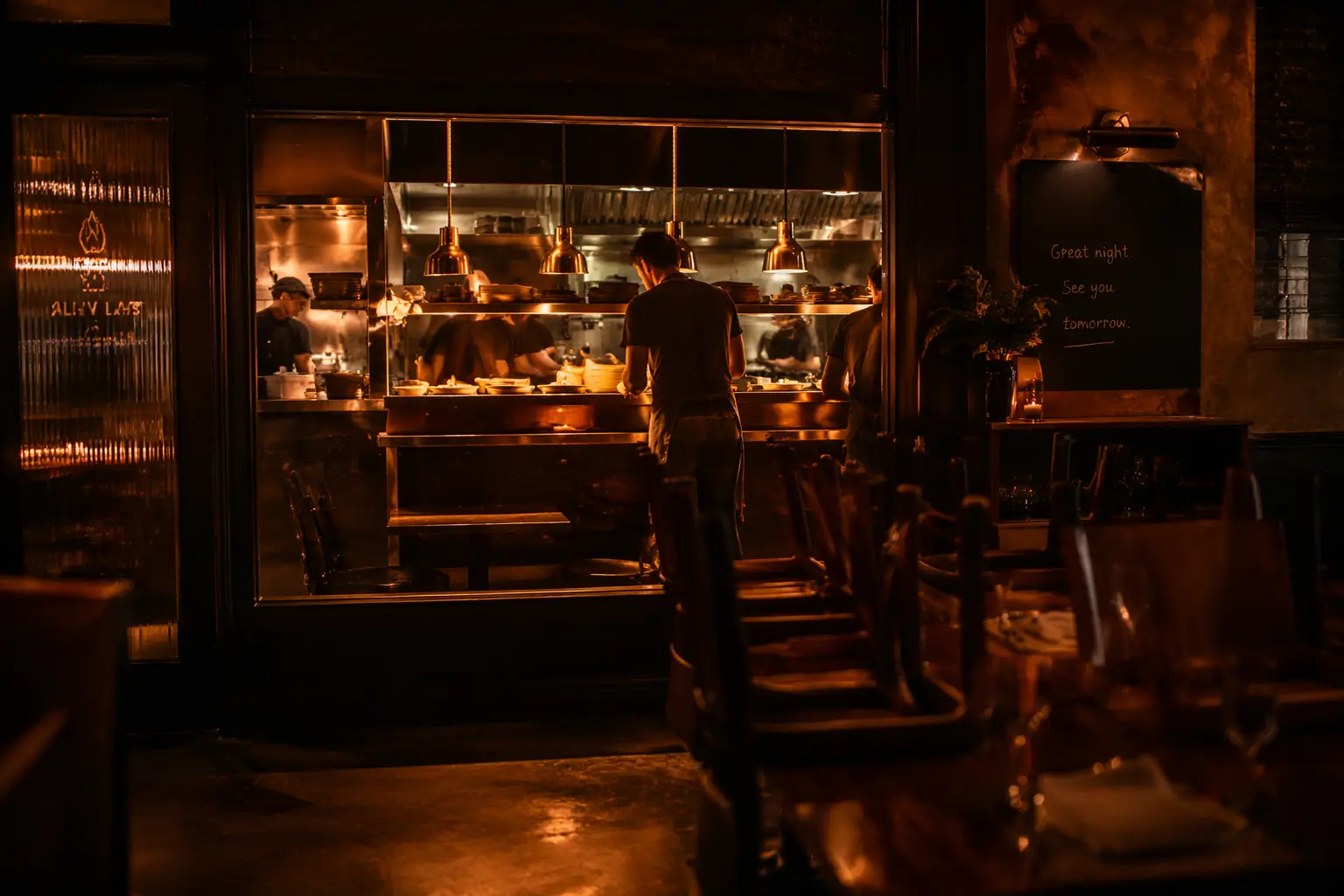
You leave your restaurant at close, hand over to the night manager, and go home. You check your system before bed: covers, revenue, inventory notes. Everything looks fine.
What you don't see: whether your team was actually executing your standards when you weren't there. Whether the bar flow was bottlenecking during rush. Whether customers were waiting too long at the host stand. Whether a table in the corner sat abandoned for 15 minutes while servers orbited it.
Most restaurant owners operate on inherited trust. You hire people you believe in, set systems, and assume they're working. Sometimes they are. Sometimes they're not. And you have no direct way to know.
That's the operational liability most owners don't talk about. It's not dramatic. It doesn't result in a single catastrophic failure. It's the slow erosion of quality and efficiency that happens in all the hours you're not present.
Operational visibility in a restaurant means real-time awareness of service execution, customer flow, and staff performance, not through surveillance, but through behavioral analytics that measure outcomes without identifying individuals.
Why Restaurant Standards Slip Without Visibility
This isn't about blaming your team. It's about the structure of the problem.
You can't be everywhere. You can't watch every service. Managers are stretched. Staff manage to the metrics you measure and report. What you don't measure, they don't optimize. What you can't see, you can't correct.
A server provides consistently good service when you're present and rushes through tables when you're not, cutting seconds off each interaction. Average check goes down slightly. Customers feel the difference. You can't see the cause because it's invisible in aggregate numbers.
The bar manager runs an efficient service during your visits and a chaotic one other days. Customers wait for drinks. Servers get frustrated. But the daily average doesn't look terrible, so you never drill into why Thursday nights have lower revenue than Tuesdays.
A host stand processes people at normal speed during your presence and lets queues build other nights, losing walk-ins. The patterns only show as "Thursday had fewer covers than expected," not "we lost 12 people who walked in, saw a wait, and left."
None of this is malice. It's human nature. People perform differently under observation. They prioritize what they're measured on. Without visibility, you can't tell the difference between a team executing well and a team doing the minimum when supervision shifts.
The Cost of the Blind Spot
Think about what you actually measure today. Covers. Revenue. Food cost percentage. Labor cost percentage. Maybe ticket times if your POS tracks them. These are outcome metrics. They tell you what happened after it happened. They don't tell you why. They don't tell you what's happening right now. And they definitely don't tell you what's happening differently when you're not watching.
A 150-cover restaurant with a $35 average check operating at 85% of optimal efficiency is leaving $44,000 per year on the table. That's not from dramatic failures. It's from minor slippages (a few seconds per table, slightly higher check times, slightly lower conversion) compounded across hundreds of services.
Staff morale matters too. The best team members leave when standards aren't enforced consistently. They're in a restaurant where slack colleagues face no consequences, where effort isn't recognized, where the culture drifts. The owner wonders why turnover ticks up and blames external factors. The real cause is invisible.
Training decays. You teach a new server your standards. They perform well under observation. Three months later, you notice they're no longer doing what you trained them on, and you don't know when that shifted or why. You retrain. The cycle repeats.
Quality metrics decline invisibly. Your dessert plate presentation degrades slowly. Your timing between courses slips. Your greeting consistency becomes inconsistent. Each shift is small. Compounded, they're the difference between a destination restaurant and a mediocre one.
Customers notice before you do. They see the inconsistency. They stop coming back. You never know why.
What Most Operators Do
Most restaurant owners respond to the invisibility problem with one of three approaches.
The first: they increase their physical presence. Working longer hours. Being in the restaurant more. This works until burnout sets in, and then the problem returns. It doesn't scale.
The second: they hire managers and invest in training, hoping better systems enforce themselves. This helps. Managers can catch obvious problems. But even good managers can't watch everything. Standards still drift.
The third: they live with it. They accept that restaurants run inconsistently when unsupervised. They budget for the loss and move on. This is the most common approach.
All three accept invisibility as inevitable. That assumption is outdated.
What Restaurant Operations Monitoring Actually Shows You
Imagine you leave your restaurant and retain operational awareness. Not in the paranoid-surveillance sense. In the "I can see whether my team is executing the standard I set" sense.
You'd see wait times at the host stand and bar in real-time. Server response times: how long between a customer request and when it's addressed. Dwell time per table and how it correlates with spending and satisfaction. Ticket times from kitchen to pass. Flow bottlenecks that slow service and frustrate customers. Times when areas are under-staffed or under-utilized. Deviation patterns: when performance dips, with enough resolution to identify root causes. Actual customer behavior: which menu items get looked at, where customers spend time, what drives purchasing.
The second you have visibility, you can manage. You can see whether a manager is executing your vision. You can spot when training decays and reinforce it. You can identify systemic problems (bad layout, slow kitchen, inefficient process) versus team problems (inconsistent execution) and address each appropriately.
You also get a feedback loop you never had before. You make a change (move the host stand, adjust lighting, retrain staff on greeting protocol) and you measure the impact directly. Did it improve the metric that mattered? If not, revert. If yes, scale it.
That's a fundamentally different operating model than the one most restaurants use.
Why Now
This was theoretically possible before. You could hire someone to sit and observe. You could install cameras and manually watch hours of footage. Neither was practical. The cost exceeded the benefit for most operators.
What changed is that the technology became viable and affordable. Modern instrumentation can tell you what's happening in your restaurant without requiring manual observation. The data is continuous, timely, and you can act on it.
More importantly, the AI layer makes the data interpretable. Raw video is overwhelming. Modern systems can watch your restaurant and tell you the specific problems and their impact. That's the conversion from data to insight that makes the investment worthwhile.
This isn't a luxury reserved for chains with 500 locations and a dedicated analytics team. The cost of sensing technology has dropped dramatically. The AI that interprets the data has become accessible. And the integration with existing systems (your POS, your reservation platform, your scheduling software) is getting simpler. A single-location restaurant can now afford the same behavioral visibility that was previously available only to the largest operators.
Operations Monitoring vs. Surveillance: What's the Difference
This distinction matters. Surveillance tracks individuals: who they are, what they said, where they went. Operations monitoring tracks patterns: how long tables turn, where flow bottlenecks form, whether service standards hold across shifts. The difference is architectural, not just philosophical. A well-designed monitoring system captures behavioral signals without identifying individuals. It tells you that average table turn time increased by 8 minutes on Thursday night, not that a specific server was slow. It shows that the bar area had a 15-minute queue at 8 PM, not which customers were waiting. The output is operational insight, not personal data. Teams respond better to this distinction too. Monitoring that focuses on systems and standards, not individuals, gets adoption instead of resistance.
The Competitive Advantage
Restaurants that can see what's happening when they're not there operate at a fundamental advantage.
They catch performance decay before it becomes customer-visible. They know when a manager needs support before that support is desperately needed. They measure the impact of changes, so they invest in improvements that actually move the needle. They maintain consistency across services, which builds customer loyalty.
Teams also respond to visibility. Not out of fear, but because standards are consistent and reinforced. People who are executing well know their effort is recognized. People who are slipping receive correction. Culture doesn't drift. Training sticks.
The financial impact is not speculative. Better execution, higher average checks, higher cover counts, lower waste, lower turnover. These are measurable improvements, and they compound.
This operational visibility is one piece of a larger picture. For the strategic layer (knowing what your competitors are doing while you optimize your own operations), see how competitive intelligence works for restaurants. And for the retention layer that keeps customers coming back after you've optimized the experience, see the 5-minute loyalty program.
The Next 18 Months
Restaurants will bifurcate. Some will gain the visibility advantage and pull ahead. They'll optimize more effectively. They'll maintain consistency. They'll know what's happening when they're not there.
Others will continue operating blind, assuming consistency and hoping management systems work. They'll be confused when the first group takes market share. They'll attribute it to luck or location rather than the systematic difference in operational visibility.
The gap is addressable. But it has to be closed intentionally. Visibility doesn't happen by accident.
Your restaurant has been operating in the dark for as long as you've owned it. That's not an indictment. It's just the structure most restaurants inherit. It's a structural problem, and it's solvable now.
The question is whether you want to see what's actually happening when you're not there.
Alive Labs builds the intelligence layer between the physical world and digital outcomes. Cerno makes physical spaces legible. The same logic applies to dining rooms. Request a Pilot →