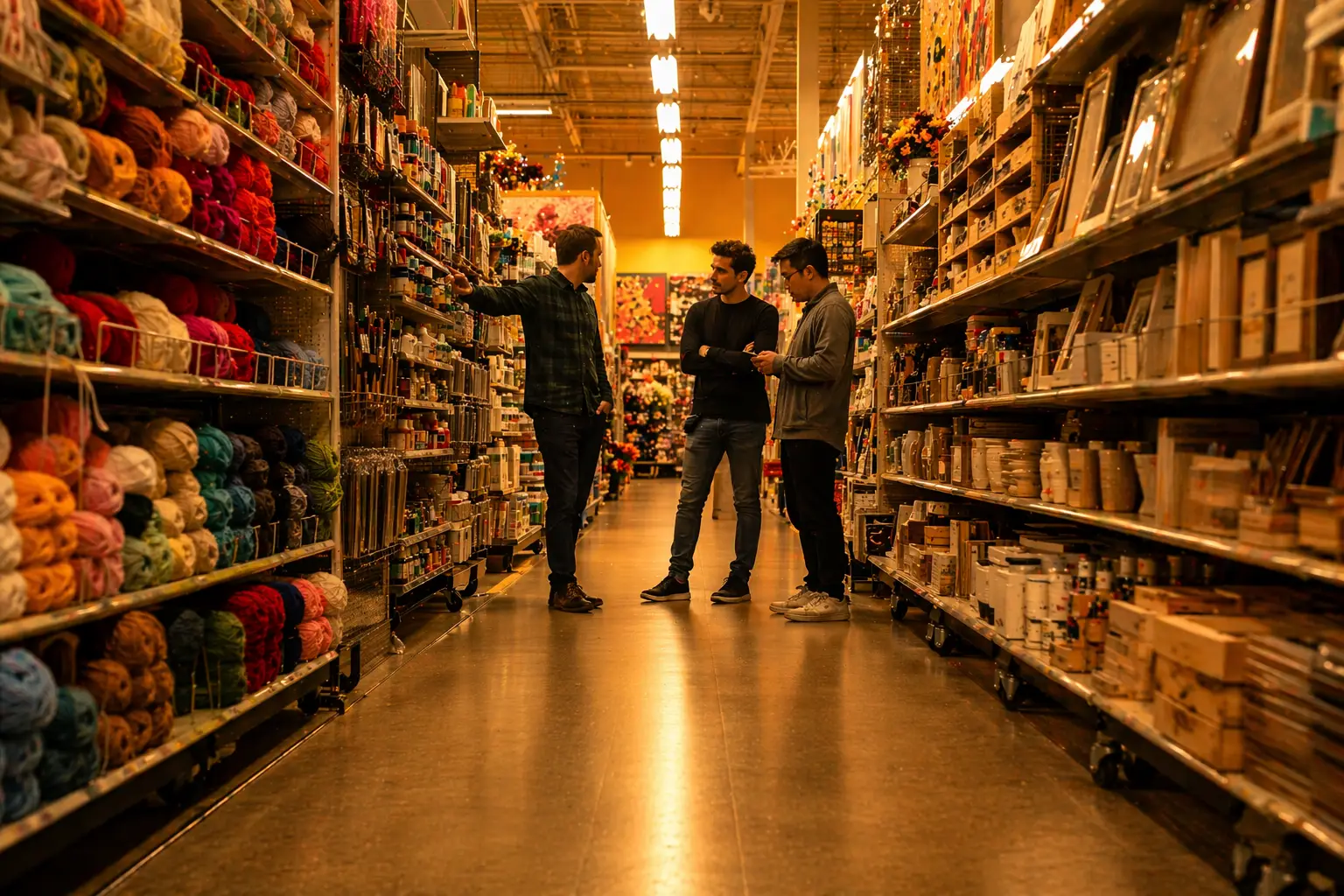
Alive Labs is a Dallas-Fort Worth product company. The three co-founders, Chris Hershberger (Chief Strategy Officer), Bryan Castles (President & Chief Experience Officer), and Vikram Sethi (Chief Technology/Information Officer), met at Michaels Stores.
The origin story of most tech companies follows a familiar arc: someone at Stanford or MIT identifies a market inefficiency, raises a seed round, and builds a product in a co-working space in San Francisco. The founders usually have computer science degrees, venture capital connections, and a pitch deck before they have a customer.
Alive Labs didn't start that way.
It didn't start in any single place. The three founders met at Michaels Stores, the arts and crafts retailer with over a thousand locations. By then, each of them had been working on a different problem that turned out to be the same problem.
Three Different Roads to the Same Aisle
Chris Hershberger came from marketing and brand strategy. He'd spent years building campaigns, learning how brands talk to customers and the mechanics of attention, persuasion, and conversion.
Bryan Castles came from product design, the production kind, where design means shipping software used by millions of people under real constraints. His instinct has always been the same: reduce friction, increase clarity, make the interface disappear so the outcome becomes obvious.
Vikram Sethi came from enterprise technology and engineering operations. He'd spent decades making complex systems work under real-world constraints: limited budgets, legacy infrastructure, organizations that resist change, timelines that don't flex. His lens was always architectural: how do you build something that works today and still works when you're ten times bigger?
Chris and Bryan didn't meet at Michaels. They'd been shipping work together at MangoMobile since 2007, building campaigns that did the same thing every time: extend a physical moment into a digital one, then bring the engagement back.
McDonald's "Mobile Monopoly" extended an in-store promotion into a mobile game. AT&T's Vans Warped Tour program delivered band lineups and contest entries to fans on the festival floor. Toyota's Scion "Drive Tour" let attendees build custom ringtones at event kiosks and redeem them online afterward. Samsung's Beyoncé Experience Tour tied a nationwide concert activation to a microsite that returned branded event photos. The same shape ran through campaigns for Visa, Heineken, Miller, Levi's, Nissan, Nickelodeon, and New Balance.
Some of the work extended a physical moment into a digital one. Some of it used digital to drive physical action: a text reminder before an event, a wallet credential on a phone that gated entry to a venue, a campaign that pulled people back to a coffee shop they'd visited once. The takeaway, taken together, was a single fact. Physical and digital had stopped being separate channels. Customers moved between them constantly, and the brands that paid attention were the ones designing for the round-trip.
Vikram's path ran parallel, on the systems side: building the data infrastructure that lets large enterprises operate at physical scale.
These three paths (strategy, design, and engineering) eventually crossed. Different disciplines, different problems. But the same observation had been surfacing across all three of their careers long before they ended up in the same building.
The Round Trip
Most companies operate as if their digital and physical work happen in separate rooms. The website team measures sessions, conversion, scroll depth, time on page. The store team counts foot traffic, transactions, average ticket. The two teams report through different chains, attend different stand-ups, and use different vocabularies. They share a customer who never thought of themselves as digital or physical. The customer was just trying to find a thing they wanted, in whichever surface gave it to them fastest.
What the three founders had been seeing, separately, was that this division wasn't only operationally messy. It was strategically blinding.
A customer reads a review on their phone, walks past three competing restaurants, picks the one with the better sentiment, sits down, and takes a photo of the meal. Three weeks later, a wallet pass reminds them they have a reward waiting. They come back, bring two friends, and four of them tag the restaurant in a story that someone else screenshots into a Google search.
Every step in that chain crosses the line between digital and physical. Every step shapes the next one. And almost none of it was being measured, attributed, or acted on in a way that respected the round-trip nature of the journey.
Chris had been watching this as a marketer. Campaigns drove traffic, and the digital end measured itself. But what happened after someone walked into a physical space, and what those physical experiences did to subsequent digital behavior, was largely guesswork. The digital marketing world had answers for every web page and email. The physical end had surveys and sales-lift studies that arrived too late to act on, and almost no one was wiring the two together.
Bryan had been designing for it. At Amazon, at Alaska Airlines, at American Airlines, the digital products he built had instant feedback loops. The moment design crossed into physical space, the loop broke. He could see customers moving fluidly between an app, a kiosk, a screen, and a real-world action, but the design problem was making that movement feel like one continuous experience instead of four disconnected ones.
Vikram had been building the systems that would have to support it. Across General Electric, KPMG/BearingPoint, and his own firms, the infrastructure to instrument digital workflows had matured for decades. The infrastructure to instrument the physical world had not. POS, inventory, supply chain, scheduling: sophisticated. The integration layer that would let digital signals trigger physical actions, and physical signals shape digital ones, was architectural and missing.
The same loop. Three different angles. Three careers, each independently arriving at the same conclusion: physical and digital are not separate worlds. They're two halves of one customer journey, and almost no one is building for the round-trip.
The Conversation
The three of them didn't have a eureka moment in a conference room. It was gradual: conversations over time, shared frustrations, an accumulating sense that this problem was bigger than Michaels and more solvable than anyone seemed to think.
Chris would mention a campaign that drove foot traffic but couldn't prove what happened inside the store, or a wallet pass that brought customers back without anyone connecting the digital nudge to the physical visit. Bryan would describe a store redesign leadership loved but nobody could measure, or an app feature that pushed a customer toward an aisle with no way to confirm they'd ever found it. Vikram would point out that the data infrastructure existed to capture signals in both directions (sensors lifting physical activity into digital systems, digital triggers landing in physical action) but nobody was building the integration layer.
Eventually, the conversation shifted from "this is a problem" to "we could build this."
Not as a Michaels initiative. As a company, because the problem wasn't unique to any one retailer. Every physical space (every restaurant, every retail store, every hotel lobby, every event venue, every auto show floor) was on both ends of the same loop: digital actions pulling customers toward it, physical experiences feeding back into the digital signals that drove the next visit. And almost no one was building for the loop. The people best positioned to solve it weren't pure technologists who'd never worked in physical operations. They were people who'd lived inside the problem and understood it from the operator's perspective.
Building for the Round Trip
Alive Labs didn't start as an AI company. It's a product company, obsessed with a specific problem: the space between the screen and the street.
The founding thesis is simple. Physical and digital aren't separate worlds. They're two halves of one customer journey, constantly affecting each other. The businesses that win build for the round-trip, not the half they happen to control. The technology to make that possible exists. The people who understand the problem are operators, not just engineers. And the solution isn't a single product. It's an infrastructure layer that makes the round-trip observable, interactive, and provable in both directions.
That thesis led to a portfolio, not a product. Cerno reads what happens in physical spaces (presence, attention, behavior) and surfaces it as digital intelligence. Auric runs the other direction, putting branded credentials on the most personal device a customer owns and driving them back into stores, restaurants, and venues. Vatic reads the digital signals competitors emit about their physical world (menu changes, pricing moves, social activity) and briefs operators in time to act. Ticket and Neat are the first vertical products Vatic powers, built for restaurant and liquor-retail operators. Veris turns physical observation (skin, hair, environment) into digital recommendations, and digital recommendations into physical purchase.
Each product owns a leg of the round-trip. Together, they cover the loop. The architectural patterns compound across the portfolio because the founders understood from the beginning that "capture signals, synthesize intelligence, deliver actionable output, prove outcomes" is the same pipeline every time. Only the industry changes, and the direction of the trip.
Why This Story Matters
The origin story matters because it explains the company's instincts.
Alive Labs doesn't build technology looking for a problem. It builds for problems the founders experienced firsthand. The product decisions aren't driven by what's trendy in AI. They're driven by what operators actually need. The design philosophy isn't "make it look smart." It's "make the outcome obvious," which is what you learn when you've designed interfaces for people booking flights at 6 AM or navigating a Kindle in bed. The engineering approach isn't "move fast and break things." It's "build it so it works under real constraints," which is what you learn when you've deployed systems at GE and KPMG.
The conviction that physical and digital are one journey, that the round-trip is where the value lives, and that most businesses are still watching only one side of it, is something each founder had been carrying for years.
To see the products that thesis produced: Cerno instruments physical spaces. Ticket gives restaurant operators competitive intelligence. Auric turns every phone into a loyalty engine. And the founding thesis, that physical is under-instrumented rather than dead, is laid out in full in our manifesto.
Three guys from Michaels saw that. They'd each been seeing it for years. Now they're building it.
That's not a Silicon Valley story. It's a Dallas-Fort Worth story about people who'd been working with the same gap across decades and disciplines, recognized each other in the same building, and decided to build what should have existed all along. The technology is sophisticated. But the origin is as practical as a craft store aisle: someone noticed that the line between physical and digital was being crossed thousands of times a day, in both directions, and decided to build for the round-trip instead of half of it.
Alive Labs builds products for the space between the screen and the street. Five products. One thesis. The line between physical and digital gets crossed thousands of times a day, in both directions. We build for the round-trip. See what we're building →