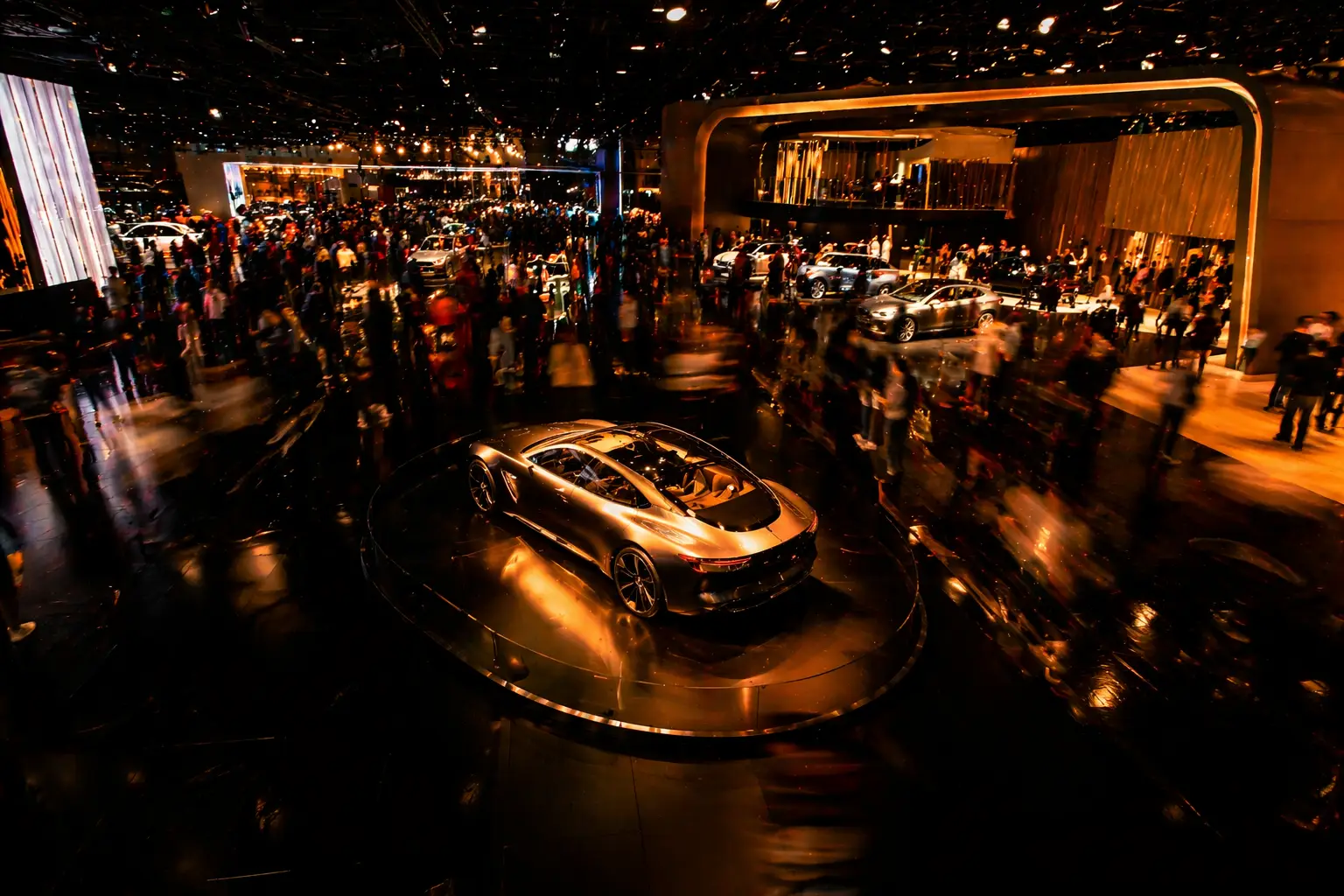
A customer walks into an auto show. They spend four minutes inside a concept SUV. They circle the electric sedan twice, crouch down to inspect the wheel design, then move to the next exhibit. They never talk to a sales representative. They never scan a QR code. They leave the booth and walk to a competitor's display.
That interaction contained at least a dozen behavioral signals: intent, preference, comparison shopping, feature interest, price sensitivity. Every single one of them disappeared the moment the customer walked away.
Now consider the same customer browsing that manufacturer's website. They'd generate a detailed behavioral profile in under two minutes: pages viewed, time on page, scroll depth, mouse movement, click patterns, comparison tool usage, configuration selections, exit page. The marketing team would know exactly what this person cared about and what content to serve them next.
The gap between these two experiences isn't a technology problem. It's an infrastructure problem. E-commerce built measurement into its foundation. Physical experiences never did.
Auto shows are a multi-billion-dollar global industry. Manufacturers spend millions per event on booth design, staffing, logistics, and creative. Yet the measurement infrastructure at most shows is functionally identical to what it was in 1995: badge scans at the entrance, manual lead capture forms, and post-event surveys with single-digit response rates.
It's time to close that gap.
Event engagement measurement is the practice of capturing real-time visitor behavior (movement patterns, dwell time, interaction depth, and conversion pathways) at physical events like auto shows, trade shows, and brand activations. It applies the same measurement discipline that transformed e-commerce to one of the largest in-person marketing categories in the world.
What E-Commerce Figured Out Twenty Years Ago
E-commerce didn't start with sophisticated measurement. The first online stores tracked page views and transactions. That was it. Over time, the measurement infrastructure evolved because operators realized that understanding customer behavior between arrival and purchase was where all the optimization lived.
The evolution followed a clear pattern. First came basic traffic measurement: how many people visited, where they came from. Then behavioral measurement: what they did on the site, where they spent time, where they dropped off. Then engagement measurement: how deeply they interacted with content, products, and tools. Then attribution measurement: which touchpoints actually influenced the purchase decision. Then predictive measurement: using behavioral patterns to anticipate what a customer would do next.
Each layer built on the one before it. Each layer made the business smarter. By the time modern e-commerce hit its stride, the measurement infrastructure was generating more strategic value than the creative work it was measuring.
Physical experiences haven't made it past layer one. Most auto shows are still counting badge scans.
Why Auto Shows Don't Measure Booth Engagement
Walk through a major auto show as a measurement professional and the absence is striking.
Manufacturers invest enormous effort in booth design. The lighting is engineered. The vehicle placement is deliberate. The staffing patterns are planned. Every element is designed to create engagement and drive outcomes.
But nobody measures whether the design works.
Which vehicle placement generates the most dwell time? Nobody knows. Does the elevated platform display outperform the floor-level display? Nobody's tested it. Are visitors spending more time with the electric lineup or the performance lineup? The data doesn't exist. Do customers who interact with the configurator kiosk convert at higher rates than those who don't? There's no way to tell. Is the booth layout creating bottlenecks that push visitors toward competitors? Invisible.
The decisions about next year's booth (which vehicles to feature, how to arrange the space, where to place interactive elements, how to staff the floor) are made based on anecdote, tradition, and the preferences of the design team. Not data.
This would be unthinkable in e-commerce. No retailer would redesign their website based on the creative director's instincts about what "feels right." They'd A/B test. They'd measure. They'd optimize based on what actually drives conversions.
Auto shows spend ten times what most e-commerce sites spend on a single campaign, with a fraction of the measurement rigor.
What Measurement Would Change
Imagine an auto show booth with e-commerce-grade measurement. Not surveillance cameras and facial recognition, but behavioral infrastructure that understands how visitors move through and interact with the space.
You'd know traffic flow patterns: which paths visitors take through the booth, where they enter, where they exit, where they cluster, where they pass through without stopping. This alone would transform booth design. You'd see that 60% of visitors enter from the left but the hero vehicle is positioned for right-side approach. You'd see that the configurator kiosk in the back corner gets a third of the traffic it would get if placed along the main flow path.
You'd know dwell time by zone and vehicle: which displays hold attention, which get a glance and nothing more. You'd discover that visitors spend an average of 47 seconds with the EV display but 2 minutes and 12 seconds with the performance hybrid, information that directly informs product positioning and marketing strategy, not just booth design.
You'd know engagement depth: the difference between someone walking past a vehicle and someone who opens the door, sits inside, adjusts the mirrors, and explores the dashboard. These are fundamentally different levels of intent, and they should be measured differently. A booth that generates 10,000 walk-bys and 200 deep engagements is performing very differently from one that generates 6,000 walk-bys and 800 deep engagements, even though the first looks better on a badge-scan report.
You'd know conversion pathways: what sequence of interactions leads to a lead capture or test drive request. Maybe visitors who interact with the configurator first and then sit in the vehicle convert at 3x the rate of those who do it in reverse order. That's actionable. That changes how you design the experience flow.
You'd know competitive movement: when visitors leave your booth for a competitor's and vice versa. You'd see that 40% of visitors who leave your EV display walk directly to a specific competitor's EV display. That's competitive intelligence you can act on.
And you'd know staff effectiveness: which conversations lead to engagement and which lead to disengagement. Not monitoring individual performance, but understanding which interaction models work best for different visitor types.
The ROI of Measuring Auto Show Booth Performance
Auto show measurement isn't just about satisfying curiosity. It's about protecting and optimizing a massive investment.
A major manufacturer spending $3 million on a single auto show booth with no behavioral measurement is making a $3 million bet based on instinct. They'll evaluate the event based on badge scans, lead forms collected, and the subjective assessment of the team on the ground. They'll make next year's decisions based on the same inputs.
A manufacturer spending $3 million plus a fraction of that on measurement infrastructure will know exactly which elements of their $3 million investment performed and which didn't. The kind of finding that becomes possible: the interactive display drove several times more qualified leads per visitor than the static display. The right-side vehicle placement underperformed the left-side placement by a measurable margin. Staff interactions longer than 90 seconds correlated with a meaningful lift in lead capture.
Next year, they'll optimize. They'll reallocate their $3 million based on what actually worked. Over three years of measurement-informed optimization, the performance gap between the measured booth and the unmeasured booth compounds dramatically.
The math isn't complicated. If measurement-informed optimization improves lead capture efficiency by 20% (a conservative estimate based on what e-commerce routinely achieves), a manufacturer generating 5,000 leads per show at a $600 cost-per-lead saves $600,000 annually. The measurement infrastructure pays for itself in the first event.
Why Now
Three things make this practical today that weren't practical five years ago.
First, sensing technology has become reliable and unobtrusive. Modern spatial analytics can understand visitor behavior without disrupting the experience. The infrastructure fits into existing booth designs without requiring visitors to wear badges, download apps, or change their behavior.
Second, AI makes the data interpretable in real time. Raw movement data is overwhelming. Modern systems synthesize behavioral signals into actionable insights, not just after the event, but during it. A booth manager can see mid-day that a zone is underperforming and adjust staffing or signage before the afternoon rush.
Third, the integration layer now exists. Behavioral data from the physical space can connect to CRM systems, marketing automation platforms, and sales pipelines. The physical engagement becomes part of the customer's digital profile, enabling attribution that bridges the gap between the show floor and the eventual purchase.
This measurement infrastructure is exactly what Cerno provides. For the broader thesis on why physical spaces deserve the same analytics rigor as digital ones, see Physical Isn't Dead: It's Under-Instrumented. For how the same attribution challenge plays out in experiential marketing, see Attribution Doesn't End at the Screen.
Measured vs. Unmeasured Events: What Changes
| Dimension | Unmeasured Auto Show Booth | Measured Auto Show Booth | |-----------|---------------------------|-------------------------| | Booth design decisions | Based on instinct and tradition | Based on prior engagement data | | Vehicle placement | Designer preference | Optimized by traffic flow and dwell time | | Staff deployment | Uniform across zones | Weighted to high-engagement areas | | Lead quality | Badge scans (volume only) | Engagement depth + conversion pathway | | ROI calculation | Cost per badge scan | Cost per qualified engagement | | Year-over-year improvement | Anecdotal | Data-driven, compounding | | Competitive intelligence | None | Visitor flow between your booth and competitors |
The gap between these two approaches compounds over time. Each measured show makes the next one better. Each unmeasured show repeats the same unknowns.
The Competitive Divide
Auto shows are about to bifurcate into two categories: measured and unmeasured.
Manufacturers who measure will optimize faster, spend more efficiently, and build institutional knowledge about what works in physical environments. They'll know which booth designs drive engagement. They'll know which vehicle positions generate interest. They'll know which staff interaction models convert. Each show will be better than the last because the feedback loop is real.
Manufacturers who don't measure will continue spending based on instinct, evaluating based on badge scans, and wondering why their cost-per-lead keeps climbing while their competitors' keeps dropping.
E-commerce figured this out twenty years ago: measure everything, test constantly, optimize based on data. The brands that applied this discipline pulled ahead and never looked back.
Auto shows are next. The technology exists. The ROI case is clear. The only question is who measures first.
At a 200,000-square-foot convention center, with 50,000 visitors over four days, the difference between measured and unmeasured is roughly 47,000 behavioral signals per hour that either inform your next decision or vanish into the air.
Cerno is experiential intelligence from Alive Labs. Sense. Engage. Orchestrate. Measure your next event with the same rigor you measure your website. Request a Pilot →